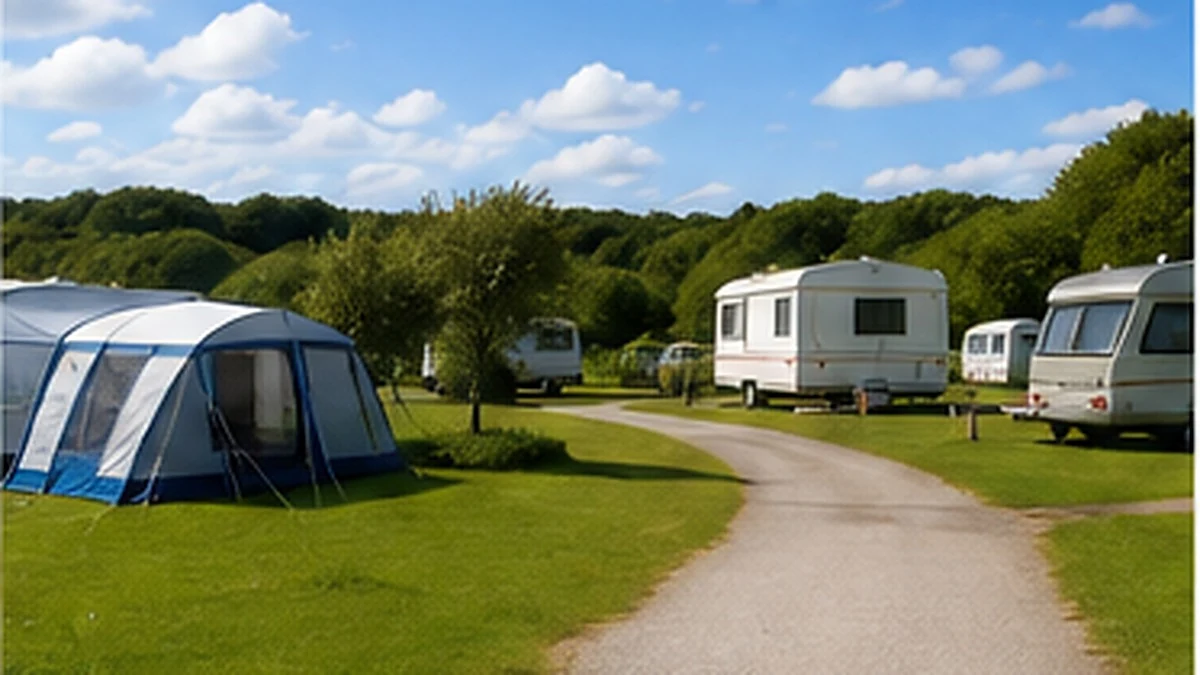
- DWI expressly lists caravan sites, camp sites and similar facilities using a private source as Regulation 9 commercial/public supplies, whether seasonal or open all year.
- The source matters: water taken from a borehole, spring, well or similar private source is different from public-mains water that a site operator merely redistributes, which may fall under Regulation 8.
- Regulation 9 monitoring uses Group A and Group B parameters at frequencies linked to volume, plus additional parameters identified by the local-authority risk assessment.
- Touring sites need records that reflect variable occupancy, seasonal shutdown/reopening, long distribution networks, standpipes, amenity blocks, treatment capacity and guest incident arrangements.
Which regulation applies to a campsite water supply?
For an England campsite using water from its own borehole, spring, well, stream or similar private source, the commercial/public use is the important point. DWI's Regulation 9 guidance explicitly includes caravan sites, camp sites and similar facilities, whether seasonal or open all year. Regulation 9 is not limited to large parks: commercial or public activity is a separate route into Regulation 9 from the 10 m³/day volume threshold.
Do not assume every privately managed pipe network on a campsite is Regulation 9, though. DWI distinguishes a Regulation 8 private distribution system, where consumers receive water originating from a water company's public supply through a third party. A touring park supplied from the public mains and then distributing that water around its own network can therefore have a different regulatory category from a park abstracting its own groundwater.
Mixed arrangements need particular care. If a site uses a private source as well as public-mains water, explain the complete arrangement to the local authority rather than classifying individual taps yourself. The local authority is the regulator and determines the statutory risk-assessment and monitoring programme.
Campsite water use and distribution
A campsite can put the same source through many very different points of use: drinking-water standpipes, washing-up sinks, shower and toilet blocks, staff facilities, motorhome service points, glamping units and sometimes cafés or other food premises. That makes the distribution network a central part of managing the supply.
Keep a current source-to-tap plan showing the source, raw-water storage, pumps, treatment stages, treated-water storage, principal distribution branches and consumer areas. DWI's records and schematics guidance says accurate plans, maintenance records and supply schematics are important evidence for the local-authority risk-assessment process.
For a touring site, the plan should be practical rather than decorative. Label amenity blocks and standpipe zones, identify any branches that are isolated outside the season, and record which treatment arrangement supplies each area. If new pitches, glamping pods, a café or another amenity block are added, update the schematic rather than leaving the authority or contractor to work from an old layout.
Risk assessment and changes
For Regulation 9 supplies in England, the local authority must carry out the statutory Regulation 6 risk assessment and keep it under review. DWI guidance states that each private water supply must be risk assessed at least every five years, and that a review should also be undertaken when the authority considers the assessment inadequate or circumstances have changed significantly.
On a campsite, changes worth recording include a new source, replacement treatment, additional storage, extra pitches or buildings, altered pipework, a change in occupancy pattern, a significant raw-water change or an incident that exposes a weakness in the existing controls. Your operational records do not replace the council's risk assessment, but they make it much easier to show what has changed since the last one.
There is also a specific rule for a genuinely reinstated supply. DWI's Regulation 13 guidance covers an existing private supply brought back into use after 12 months of non-use. In that situation, the supply should not simply be reopened to guests: the local authority must carry out the required risk assessment and determine monitoring arrangements before it is put back into domestic use.
Monitoring and sampling
Regulation 9 monitoring is more structured than a one-off private laboratory test. DWI states that Regulation 9 supplies must be monitored to the Group A and Group B specifications in Schedule 2, at frequencies driven by the volume consumed, with any additional monitoring shown to be necessary by the risk assessment. DWI describes the minimum frequency for Regulation 9 supplies as once a year.
A campsite's many outlets do not create a rule that every standpipe must be sampled on every visit. DWI's monitoring and sampling guidance says regulatory samples are normally taken from a single suitable point of use that best represents the water being consumed and the hazards identified by the risk assessment, unless the system has circumstances such as multiple independent treatment arrangements. Where appropriate, locations can be alternated over time.
Keep the full laboratory report, not just a pass/fail note. Record the exact sampling point, date, who collected the sample, the supply conditions and the authority instruction or follow-up. If a result leads to investigation or corrective work, link that result to the action and close-out evidence.
Seasonal shutdown and reopening
DWI's Regulation 9 guidance specifically includes seasonal campsites, so closing to guests for winter does not turn the site into a different category. What changes is the operational risk: long periods of low or no use can leave parts of the distribution network dormant, maintenance can drift, treatment settings can be forgotten and opening-day demand can rise rapidly.
There is no universal statutory campsite "reopening checklist" that replaces local-authority advice. Treat reopening as a controlled operational event. Record the source and headworks inspection, storage condition, treatment checks, alarms, filter or UV maintenance, relevant flushing or cleaning work, and any sampling or recommissioning requested by the authority or competent professional.
Keep winter shutdown decisions too. If parts of the network are drained, isolated or left full, record what was done and why, then use the same site plan during reopening so no branch or consumer area is forgotten.
Peak demand and treatment capacity
Touring sites can move from very low off-season use to intense morning and evening peaks. That matters because treatment performance can depend on flow. DWI's UV guidance says the manufacturer's maximum design flow rate must not be exceeded and notes that UV effectiveness is affected by water quality and flow rate.
Keep the design flow and service information for pumps, filters, UV units, dosing systems and storage with the asset records. Compare those figures with realistic peak use when the site is full, especially after expansion. DWI case material has documented private-supply failures where treatment was sized for a much lower flow than the fully occupied premises demanded.
Do not use software or a simple flow calculation to declare treatment adequate. If capacity is uncertain, use a competent water-treatment professional and retain the design or commissioning evidence they provide.
Incidents, restrictions and supply loss
A busy campsite needs a guest-facing response plan as well as technical records. If the local authority advises that water use must be restricted, the operator needs a way to identify affected areas, communicate clearly with guests and staff, and provide an alternative wholesome supply where instructed.
Keep current contact details for the local authority, laboratory, source owner where different, treatment contractor and any person who can isolate branches or arrange emergency water. Record when the incident started, symptoms or alarms reported, affected outlets, authority instructions, temporary controls, remedial work and the evidence used to return the system to normal operation.
Quantity matters as well as quality. DWI publishes separate guidance on insufficiency of private supplies. For a seasonal business, a dry source, pump failure, power interruption or treatment outage can become an accommodation problem quickly, so the contingency plan should cover both unsafe water and no water.
Records a campsite operator should be able to find quickly
- Current local-authority risk assessment and monitoring schedule.
- Full Group A/Group B and any additional laboratory reports, with exact sample points.
- Source-to-tap schematic covering treatment, storage, amenity blocks, standpipes and other consumer areas.
- Seasonal shutdown and reopening records, including any authority or contractor advice.
- Treatment asset details, maximum design flows, servicing, filters, UV lamp/sleeve work, alarms and repairs.
- Tank, source, headworks, pump and distribution inspections.
- Site changes, new pitches/buildings and altered pipework.
- Incidents, restrictions, complaints, corrective actions and close-out evidence.
- Emergency contacts and alternative-water arrangements.
- Clear responsibility records where the source or parts of the network are controlled by different people.
Practical campsite checklist
- Confirm with the local authority whether the site is Regulation 9, Regulation 8 or another category based on the actual source and distribution arrangement.
- Keep the current risk assessment and monitoring programme accessible.
- Update the site water schematic whenever pitches, blocks, storage, treatment or pipework change.
- Record shutdown and reopening work rather than relying on staff memory.
- Check treatment capacity against real peak demand and retain competent verification.
- Keep sampling locations and full results linked to the correct area of the network.
- Give staff a simple escalation route for alarms, unusual taste/odour/colour, low pressure and guest complaints.
- Keep an incident and alternative-water plan that can be used when the site is full.
Frequently asked questions
Does a seasonal campsite with its own borehole still fall under Regulation 9?
Yes, where the private-source water is supplied as part of the campsite or caravan-site commercial/public activity. DWI explicitly lists caravan sites, camp sites and similar facilities whether seasonal or open all year. The local authority determines the regulatory arrangements for the actual supply.
What if the site water comes from the public mains and is then distributed around the park?
That can be a Regulation 8 private distribution system rather than a Regulation 9 private-source supply. Tell the local authority exactly where the water originates and how it is distributed; mixed public and private sources can change the position.
Does every standpipe or amenity block need a regulatory sample?
No universal rule requires every outlet to be sampled on each visit. DWI says regulatory samples should be taken from a suitable point of consumption that represents the water and the risks. The local authority chooses the monitoring and sampling arrangement.
What happens if a private supply has been out of use for 12 months or more?
DWI guidance on Regulation 13 treats an existing supply reinstated after 12 months of non-use as a reinstated supply. It should not be put back into domestic use until the local authority has completed the required risk assessment and determined the monitoring arrangements.
How often is a Regulation 9 campsite supply tested?
Regulation 9 supplies are monitored for Group A and Group B parameters at frequencies set according to the volume consumed, with additional monitoring where the risk assessment shows it is necessary. DWI describes the minimum monitoring frequency for Regulation 9 supplies as once a year.
Why does peak occupancy matter for treatment?
Treatment has to work at the real flow through the system. DWI guidance for UV units says the maximum design flow rate must not be exceeded, and DWI case material highlights the risk of treatment that is undersized for peak demand.
Keep campsite water records tied to the real site layout.
Use the free tools or start a 7-day trial to organise sampling, treatment maintenance, reopening work, incidents, documents and corrective actions around one source-to-tap record.
- DWI: Regulation 9 commercial and public supplies
- DWI: Types of private supplies in England (Regulations 8, 9 and 10)
- DWI: Regulation 6 risk assessment
- DWI: Regulation 7 monitoring and sampling locations
- DWI: What sampling is required?
- DWI: Regulation 13 new and reinstated supplies
- DWI: UV disinfection
- DWI: Examples of records and schematics
- DWI: Managing insufficiency of private water supplies
- Legislation.gov.uk: Private Water Supplies (England) Regulations 2016
- Legislation.gov.uk: Private Water Supplies (England) (Amendment) Regulations 2018
This guide is England-focused. Wales, Scotland and Northern Ireland have different private-water-supply legislation and regulatory arrangements. Regulatory guidance can change; check the current DWI material and your local authority for the position applying to your supply.