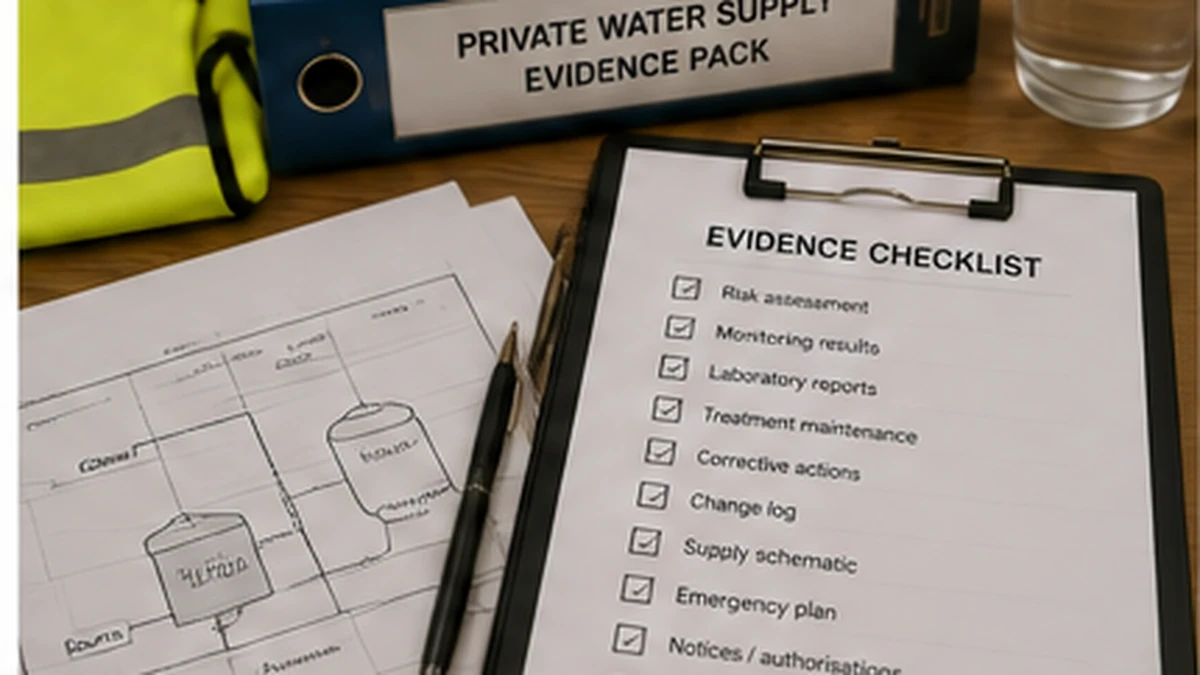
- Separate the council's Regulation 14 record from your own operational evidence.
- Keep original reports and notices; use summaries to navigate them, not replace them.
- Organise records around one supply and consistent asset/sample-point names.
- Link failures to investigations, corrective actions and close-out evidence.
- Keep personal information proportionate, secure and only for as long as needed.
- What an evidence pack is
- Regulation 14: the council's statutory record
- What relevant persons should be able to provide
- Core evidence checklist
- Original documents versus summaries
- Retention: what 30 years really means
- Changes, failures and corrective actions
- Handover, sale and due diligence
- Privacy and personal data
- What the member evidence pack actually produces
- Keeping the pack current
- England versus other UK nations
- Frequently asked questions
1. What is a private water supply evidence pack?
An evidence pack is a structured collection of records that makes the history and current state of a private water supply understandable. It should tell a competent reader what the source is, where the water goes, what treatment and storage are present, how the supply is monitored, what has changed, what problems have occurred and what evidence supports the answers.
The useful part is the structure and traceability, not the name. The Private Water Supplies (England) Regulations do not create an operator document called an “evidence pack”. A folder containing well-labelled originals, a current schematic and an index can be more valuable than a glossy report that hides gaps in the underlying record.
DWI's examples of records and schematics say accurate records, maintenance diaries, schematics and plans are important to the risk-assessment process. DWI also says local authorities can gather information from relevant persons ahead of a risk-assessment visit, while still verifying it on site. That is the practical reason to assemble evidence before someone asks for it.
2. Regulation 14: understand the council's statutory record
Regulation 14 is a local-authority duty. DWI's current England note says each local authority must maintain a record of all private water supplies in its area. The information is prescribed by Schedule 4 and is reviewed through the authority's annual data return.
The authority's record includes core supply facts such as source type and location, an estimate of the people and volume served, premises type and treatment details. Within 28 days of information becoming available, Schedule 4 also requires items such as a plan and description of the supply, monitoring programme, sample dates/results/locations/reasons, investigation results, relevant notices, agreed actions, requests/advice and risk-assessment summaries.
DWI says the local authority should record significant changes in circumstances as they happen—for example a revised risk assessment, monitoring trends, or installation/upgrading of treatment where it affects the risk assessment.
The Regulations do not generally require relevant persons to “register” a supply themselves. However, DWI explains that if a local authority becomes aware of a previously unknown supply it must add it to its records, and it can use section 85 of the Water Industry Act 1991 where necessary to require a relevant person to provide information needed for its regulatory functions.
3. What should an owner or relevant person be able to provide?
DWI's records-and-schematics guidance goes further than the council's database and describes the information that relevant persons should be able to provide ahead of risk assessment. This is guidance for effective management and assessment, not a separate statutory “evidence pack” requirement.
In practical terms, be ready to explain and evidence:
- where the source is and what type of source it is;
- how water travels from source through treatment, storage and distribution to consumers;
- which premises, activities and approximate population/volume are served;
- what treatment is installed, where it is, and how it is operated and maintained;
- where samples are taken and what the laboratory/local authority reported;
- what defects, incidents or failures have occurred and what happened next;
- who manages the supply and who holds key operational/professional roles;
- what has changed since the last risk assessment or monitoring programme was set.
Use the source-to-tap schematic guide to turn this into a visual system map. DWI's own examples include catchment plans, supply plans and treatment schematics because these make hazards and responsibilities much easier to inspect.
4. Core evidence checklist: what to include and why
| Evidence | Why it matters | Status |
|---|---|---|
| Supply summary Source, premises/users, local authority, responsible/relevant persons, supply reference. | Gives every other document context and helps identify the right supply. | Supports Regulation 14 / risk assessment |
| Current supply plan / schematic Source, treatment, storage, distribution, sample/consumer points. | DWI says a plan and description form part of the local-authority record and risk-assessment process. | LA statutory record; operator should be able to provide/verify |
| Risk-assessment material Latest authority assessment/summary and evidence used to support it. | Shows identified hazards, controls and actions. Keep the authority original where supplied. | LA statutory process; operator supporting evidence |
| Monitoring programme and sampling history Sample dates, locations, reasons, lab/authority references and reported outcomes. | Schedule 4 requires the authority to record monitoring and sample information; your copies let you trace what was tested and why. | LA statutory record; keep operator copies |
| Original laboratory reports | Preserves the actual reported result, method/reference and any qualification. A dashboard summary is not a substitute. | Strong operational evidence |
| Treatment/asset register Make/model/ref, installation, service information and operating instructions. | DWI recommends keeping management and maintenance information for treatment systems. | DWI-recommended evidence |
| Maintenance/service history Filter changes, UV lamp/service work, tank inspections, pump work and faults. | Shows whether important controls are actively managed and supports risk assessment and investigation. | DWI-recommended/good practice |
| Failures, investigations and corrective actions | Connects a problem to immediate controls, investigation, repair, follow-up and closure rather than leaving an unexplained failed result. | Authority records investigation/action; operator evidence supports it |
| Notices, authorisations and authority correspondence | Preserves the exact legal/professional instruction and dates. Schedule 4 requires the authority to record specified notices/actions/advice. | Keep originals supplied to you |
| Significant change history Source, treatment, storage, distribution, use, occupancy or responsibility changes. | DWI says authorities should note significant changes; your chronology helps them understand what changed and when. | Operational evidence supporting LA record/review |
| Emergency/resilience information | Contacts, isolation points, alternative water and response arrangements speed up safe action during an incident. | Operational preparedness |
| Photographs | Useful when they show asset identity, condition, repairs, access points or a change that is difficult to describe. | Useful where purposeful |
Use the free Evidence Pack Checklist as a gap check. It is a planning tool: a ticked box is not proof that the underlying record is adequate.
5. Keep originals as well as summaries
A good evidence pack has two layers. The first is an index or summary that helps you find things quickly. The second is the source evidence itself. Keep the actual laboratory PDF, authority notice, risk-assessment document, installer manual or service record where it exists.
Do not retype a failed sample result into a spreadsheet and then discard the report. Do not replace a formal notice with a short note saying “council asked us to fix UV”. The original tells you the date, wording, reference, recipient and exact scope. Your summary should point to that original.
For contractor paperwork, distinguish evidence from legal requirement. A service invoice, commissioning sheet or certificate can be useful evidence of work, but this guide does not claim that every such document is mandated by the Private Water Supplies Regulations. DWI's treatment guidance does say treatment systems should come with operating/maintenance information and recommends management and maintenance records to assist risk assessment.
The same principle applies to photographs. Keep images that prove something useful: a repaired spring cover, replacement tank lid, UV serial plate, pipe route exposed during repair, or sample-point identity. Avoid collecting hundreds of near-duplicate site photographs with no date or purpose.
6. Retention: what the 30-year rule does—and does not—mean
The safest wording is precise: DWI's Regulation 14 note says the local authority's private-water-supply records must be retained for at least 30 years. It does not create a general 30-year operator retention schedule for every document in your business.
For operator records, retention depends on why the record is needed. Some evidence may remain useful for the life of an asset or supply because it explains design, ownership, repairs or historic risk. Other records may be relevant while a notice, investigation, warranty, contract, dispute or handover remains live. Do not invent a single retention period for all evidence unless another applicable law, contract or authority instruction gives one.
When a record contains personal data, retention also has a privacy dimension. The ICO's current guidance says personal data should be adequate, relevant and limited to what is necessary, and should not be kept longer than needed for the purpose. That means “keep everything forever just in case” is not a sound data-protection policy.
7. Make changes, failures and corrective actions traceable
Evidence becomes most valuable when something goes wrong or the system changes. A chronology should let you answer: What happened? When? Who knew? What was done? What evidence confirmed the outcome?
For a failed sample, link the original result to the corrective-action record, investigation/authority correspondence, repair evidence and any follow-up sampling. For an equipment or source change, link the change-management record to the updated schematic, treatment asset details and any risk-assessment discussion.
DWI specifically expects the local authority's record to capture investigation results, whether a potential health risk was identified, notices/actions and significant changes in circumstances. Good operator chronology makes those regulatory processes easier to support and reduces the chance that a future owner sees an unexplained gap.
8. Handover, property sale and commercial due diligence
A well-organised pack can make handover much better because critical knowledge is not trapped in one person's memory. A new owner, manager or contractor can see how the supply is arranged, which assets require attention and what unresolved issues exist.
For property transactions, treat the pack as supporting evidence, not a certificate. DWI advises prospective buyers of homes on private supplies to understand the supply arrangement, check deeds/agreements concerning responsibility and maintenance, and obtain legal advice where needed. The buyer may become a “relevant person” after purchase.
Useful handover material includes the latest authority correspondence, recent laboratory reports, a current schematic, treatment instructions, service history, responsibilities/agreements, open actions and known supply constraints. Use the property-purchase guide for the transaction-specific questions rather than turning this record guide into conveyancing advice.
9. Privacy and personal information
Most supply evidence is technical, but contact details, names, emails, telephone numbers, signatures, invoices or photographs can contain personal data. Keep only what is genuinely needed for the management, legal or evidential purpose. Avoid copying unrelated personal information into a pack simply because it appears on an email or invoice.
The ICO's data-minimisation principle requires personal data to be adequate, relevant and limited to what is necessary. Its storage-limitation guidance says identifiable personal data should not be kept longer than needed for the purpose. Protect access to records accordingly, especially if the evidence pack is shared with contractors, buyers or clients.
This is not a full data-protection guide. If your organisation processes substantial personal information, define a proper lawful basis, access controls and retention policy for that processing.
10. What Private Water Supply Manager's Evidence Pack actually produces
The member workspace has a supply-specific Evidence packs view. It compiles the structured records already entered for the selected supply. It does not invent missing records or certify compliance.
| Workspace output | What is included |
|---|---|
| Supply summary | Recorded category, source, local authority, responsible person, client/owner, site reference and risk-assessment date/five-year marker. |
| Supply schematic | Recorded source-to-tap nodes in their saved order. |
| Treatment & infrastructure | Recorded assets, identifiers, installation/service dates and notes. |
| Monitoring | Recorded sample dates, reasons, sample locations, laboratory/reference, action parameters and outcome. |
| Maintenance & corrective actions | Open/complete maintenance tasks and open/closed corrective actions linked to the supply. |
| Significant changes | Recorded change type, date, notes and whether risk-assessment review was discussed. |
| Emergency & resilience | Recorded alternative-water, shutdown, authority/contractor, notification and response information. |
| Professional contacts | Workspace contact records. |
| Document index | Names/types/dates/notes for documents stored against that supply. |
Use Print / save PDF in the Evidence packs tab to produce a printable snapshot of the structured pack. Use Export records for a JSON copy of the structured workspace data. These are different outputs with different purposes.
Build the pack from your real supply records
Open the workspace, select Evidence packs, choose the supply and review each section for gaps. The pack is only as complete as the records you have entered and the originals you retain.
Open the member workspace Check evidence gaps first11. Keep the evidence pack current
Do not wait for the next council visit to rebuild the history from emails. Update the record at the point the event occurs. Use consistent names for the same borehole, UV reactor, tank, branch or sample point so evidence stays connected.
- After a sample: store/index the original report and record the sample point, reason and outcome.
- After maintenance: record the asset, date, work and source of the maintenance requirement.
- After a fault/failure: create a corrective action and keep the investigation and close-out evidence.
- After a material alteration: update the schematic and change history.
- After an emergency: keep the event chronology and update the emergency plan if the response exposed a weakness.
- Before a risk assessment: use the pack to identify missing source, treatment, distribution or maintenance facts rather than guessing on the day.
Related depth guides include record keeping, risk assessment, sampling and testing, laboratory results, treatment systems and maintenance logs.
12. England versus Wales, Scotland and Northern Ireland
The Regulation 14 and Schedule 4 discussion above is specifically about England. DWI's records-and-schematics page is marked for England and Wales, but Wales has its own Private Water Supplies Regulations and its own regulation numbering. Scotland uses the Water Intended for Human Consumption (Private Supplies) (Scotland) Regulations 2017 for regulated supplies and separate 2006 rules for small domestic supplies. Northern Ireland operates its own private-water-supply regime and register.
The practical evidence principles—current plans, treatment information, monitoring history, maintenance, incidents and clear responsibilities—remain useful elsewhere, but do not copy England's Regulation 14 wording or retention rule into another jurisdiction without checking the relevant national rules.
13. Frequently asked questions
Is an evidence pack legally required for a private water supply in England?
No specific provision in the Private Water Supplies (England) Regulations requires an operator document called an evidence pack. Regulation 14 requires the local authority to maintain statutory records. DWI separately recommends accurate records, maintenance diaries, plans and schematics because they support risk assessment and active management.
Do I have to keep my operator records for 30 years?
The 30-year minimum in DWI Regulation 14 guidance applies to the local authority record of private supplies. The Private Water Supplies Regulations do not impose the same blanket 30-year retention rule on every operator document. Keep operational records for as long as they remain necessary for managing the supply, meeting applicable duties, supporting investigations, contracts or handover, and apply appropriate data-protection retention to personal information.
Should the evidence pack contain original laboratory reports and council documents?
Keep the originals where they exist. A summary or dashboard is useful for navigation, but it should not replace an original laboratory report, notice, authorisation, risk-assessment document, contractor instruction or other source evidence.
What should I include for treatment and maintenance?
Include a treatment/asset list, operating and maintenance instructions, service dates, consumable or lamp/filter changes, faults and repairs, and relevant commissioning or contractor records. DWI recommends management and maintenance records for newly installed treatment to support risk assessment.
What does the Private Water Supply Manager evidence pack actually include?
The workspace generates a supply-specific operational pack from recorded supply details, schematic, treatment assets, monitoring, maintenance, corrective actions, significant changes, emergency planning, professional contacts and a document index. It can be printed or saved as PDF. Original uploaded document files remain separate in the Documents workspace and are not embedded in the structured JSON export.
Can I keep names and contact details in the pack?
Only keep personal information that is genuinely needed for managing the supply or responding to an incident, protect it appropriately and review whether it is still needed. UK data-protection principles require personal data to be adequate, relevant and limited to what is necessary, and not kept for longer than needed for the purpose.
Is an evidence pack enough for a property sale or handover?
It is useful supporting evidence, but it is not a statutory certificate of compliance and does not replace conveyancing, title/deed checks, local-authority records, laboratory evidence or professional/legal advice. DWI advises prospective buyers to understand the supply arrangements and any agreements about responsibility and maintenance.
- DWI — Information note on Regulation 14 (England)
- DWI — Examples of records and schematics
- DWI — Record keeping
- DWI — Treatment guide and maintenance records
- DWI — Buying a dwelling with a private water supply
- ICO — Data minimisation
- ICO — Storage limitation
- DWI — Current private supply legislation (England and Wales)
- Scottish Government — Water and private supply legislation
- DAERA — Private water supplies in Northern Ireland
England-focused operational guidance. Always use the current local-authority documents and original laboratory/professional evidence for your own supply.